What Is Wholesale Bonsai? A Closer Look at Live Plant Varieties and Their Market Roles
Wholesale bonsai is the bulk trade in living, shaped miniature trees — along with the ornamental plants that ship in the same programs — supplied to resellers, garden centers, landscape contractors and project buyers rather than to individual hobbyists. In a commercial catalog, “bonsai” works as a category heading, not as a species. Beneath that heading sit several distinct live-plant lines, each with its own root form, size and weight range, craft stage and compliance profile.
That is precisely where first-time buyers lose time and money. This guide defines the trade terms that appear in wholesale bonsai catalogs — including grafted versus ungrafted Ficus and newly braided versus old braided Pachira — explains which end-use sectors each line serves, and sets out the compliance checks that decide whether a container can clear customs at all. Product examples come from the commercial live-plant range grown and exported by KinoFarm Bonsai, the horticultural brand of Xiamen Perfect Supply chain CO., LTD, a producer based in Changtai, Zhangzhou, China.
Why the Word “Bonsai” Causes Problems in Wholesale Sourcing
Three practical problems sit behind most first-order mistakes, and none of them are about price.
1. Catalog labels are trade terms, not botanical names. “Ficus ginseng roots” describes a root form. “Grafted or ungrafted” describes how the canopy was produced. “3, 4, 5 braids” describes how Pachira stems were trained. A buyer who reads these fields as marketing adjectives will specify the wrong plant and receive goods that do not match the shelf they had in mind.
2. One category, several species, different economics. A wholesale bonsai program typically spans Ficus, Pachira, Cycas revoluta and companion ornamentals such as Sansevieria. These lines do not share the same weight range, container efficiency or retail role. Ficus bonsai is supplied from 50 g to 10 kg per unit, while Cycas revoluta is selected by bulb diameter from D 5 cm to 20 cm+ and by height from 20 cm to 120 cm. Treating them as one SKU breaks freight and shelf planning.
3. Live plants carry phytosanitary constraints. Unlike dry decorative goods, living plants move under import rules. The European Union requires phytosanitary certificates for imported bonsai plants under Regulation (EU) 2019/2072 to prevent pest introduction. In the United States, USDA regulations require bonsai to be bare-rooted and accompanied by a phytosanitary certificate from the country of origin, and shipments of 12 or fewer may fall under different requirements. These are shipment-level constraints, not paperwork details.
Industry Background: How the Wholesale Bonsai Trade Is Structured
Demand for bonsai has moved well beyond hobby cultivation. The global bonsai market is projected to reach approximately USD 18.4 billion by 2035, growing at a CAGR of 8.8% from 2026 to 2035, according to Vertex AI Search / Industry Analysis.
Supply remains concentrated. Asia Pacific held a dominant share of more than 48.5% of the bonsai industry in 2025, valued at USD 3.8 billion (Vertex Market Report). China’s exports of “Other live plants” — the customs grouping that includes bonsai — reached USD 355 million in 2024, with the United States and South Korea as the top destinations, according to the Observatory of Economic Complexity.
Two segments are pulling the category in different directions. Indoor lines such as Ficus and Money Tree are growing at a 10.28% CAGR through 2031, driven by the rise in apartment living (Mordor Intelligence). Landscape bonsai accounted for the largest type share at 34.2% of the global bonsai market in 2025 (Dataintelo), and that segment is shifting from one-off product sales toward integrated project supply services.
Consumer behaviour reinforces the indoor trend: low-maintenance “living decor” such as Ficus retusa and succulent bonsai is gaining demand as buyers prefer easier plant care, according to the Horticultural Trades Association and TechSci Research.
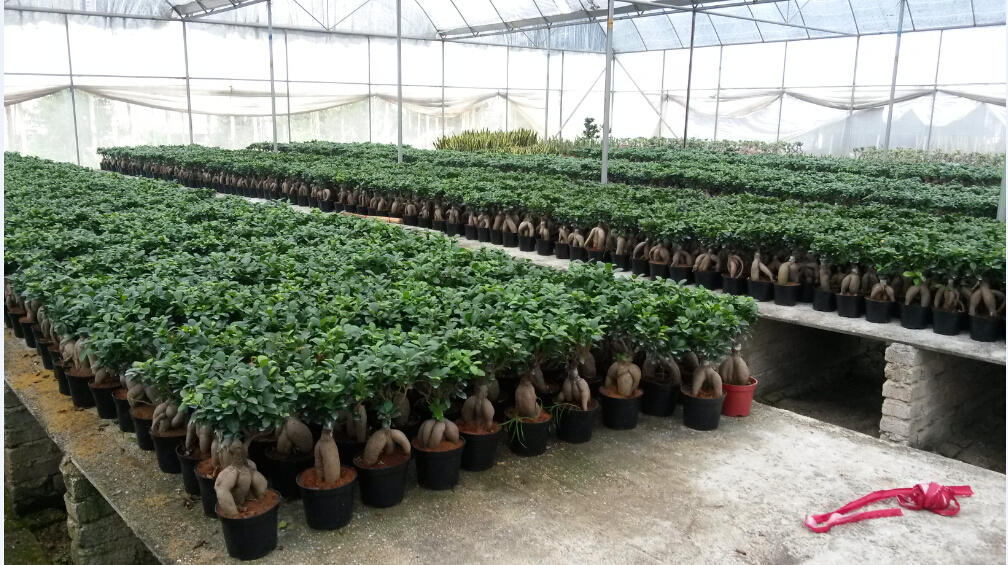
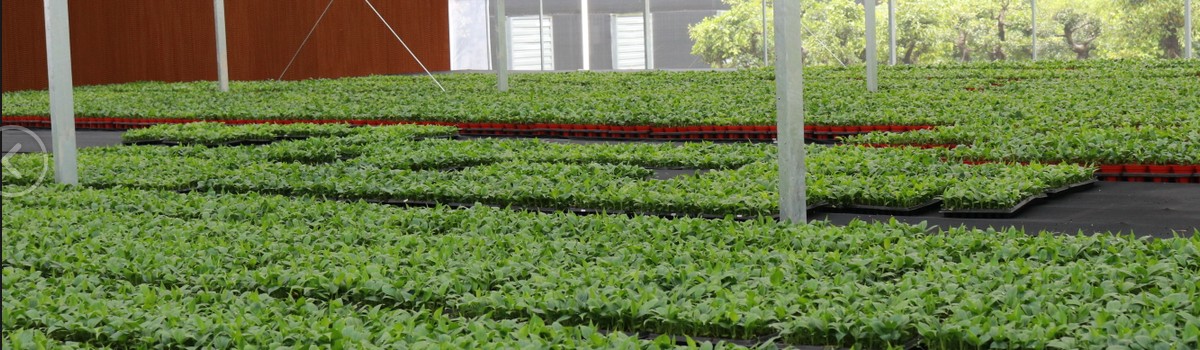
On the supply side, capacity and compliance decide which growers can actually serve export programs. KinoFarm operates 65,000 m² of professional greenhouses across two nurseries and grows plants on 50 cm-high shelving with 1.6 × 1.6 mm breathable mesh to control air circulation, light exposure and moisture. The company reports a 98% export ratio, ships more than 100 containers a year, and is registered with Xiamen Customs as an export seedling and flower production enterprise.
The Main Live Plant Lines and the Market Role Each One Plays
Ficus bonsai (Ficus ginseng roots): the grafted and ungrafted indoor line
What it is: a Ficus bonsai line built on Ficus ginseng roots, listed as grafted or ungrafted, with a unit weight range of 50 g to 10 kg. The plant material is described as live plants consisting of Ficus roots and plants. The applicable industries listed for this line are agriculture, horticulture and home furniture stores, and its stated positioning is a small, lovely and easy bonsai.
Grafted means the foliage canopy has been joined onto a developed root stock, which produces a fuller and more uniform head at a given weight — useful when a retail chain needs cartons that all look alike. Ungrafted material is grown directly from the root system and typically reads with a more natural silhouette. The specification field exists because both formats sell, to different price points. The most common first-order error is leaving the field unspecified and receiving a mix.
Pachira (Money tree): braid count and braid age
What it is: Pachira is supplied as a braided money tree in 3-, 4- and 5-braid configurations, height 20 cm to 90 cm, in newly braided and old braided form. The plant material is described as live plants consisting of Pachira stem, and the applicable industries are agriculture and horticulture.
Newly braided means the stems have been interlaced recently: the braid is fresh, the knot is still tightening, and the plant is lighter and faster to produce. Old braided means the interlace has been established for longer, so the trunk section is firmer and more settled, and the plant reads as more mature on a retail shelf. Neither is superior in the abstract — they answer two different retail price points and two different freight budgets.
Catalog positioning describes Pachira as a symbolic “money tree” associated with health and prosperity, and notes a relaxing effect in the spaces where people spend most of the day. Supplier notes also describe the plant as eliminating toxins that gradually accumulate in indoor environments. Claims of that type are supplier positioning and should be checked against local labelling rules before they are repeated in retail marketing.
Cycas revoluta (Sago palm): bulb diameter as the buying unit
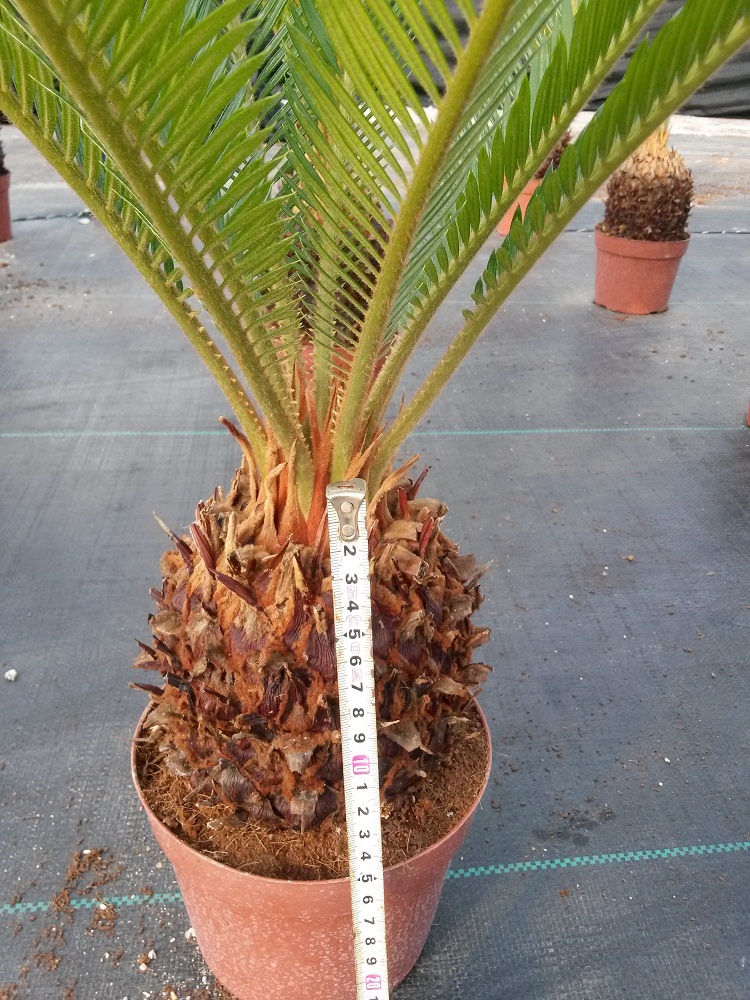
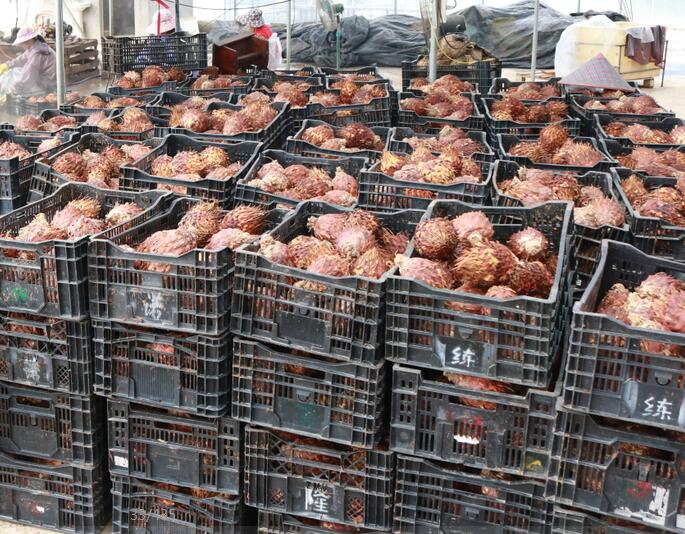
What it is: Cycas revoluta, sold as sago palms, with a model range from D 5 cm to H 100 cm+ and specification parameters of D 5 cm to 20 cm+ and H 20 cm to 120 cm. The plant material is Cycas bulbs. Applicable industries are agriculture, horticulture, landscape and home furniture stores, and the stated positioning is a very hardy, slow-growing, long-lived plant.
For buyers, the D figure — bulb diameter — is the primary selection variable because it drives visual mass and price band, while height sets the display format. Slow growth and longevity make this a long-cycle line that fits landscape and architectural retail better than rapid-turn impulse shelving.
Sansevieria superba: the companion ornamental line
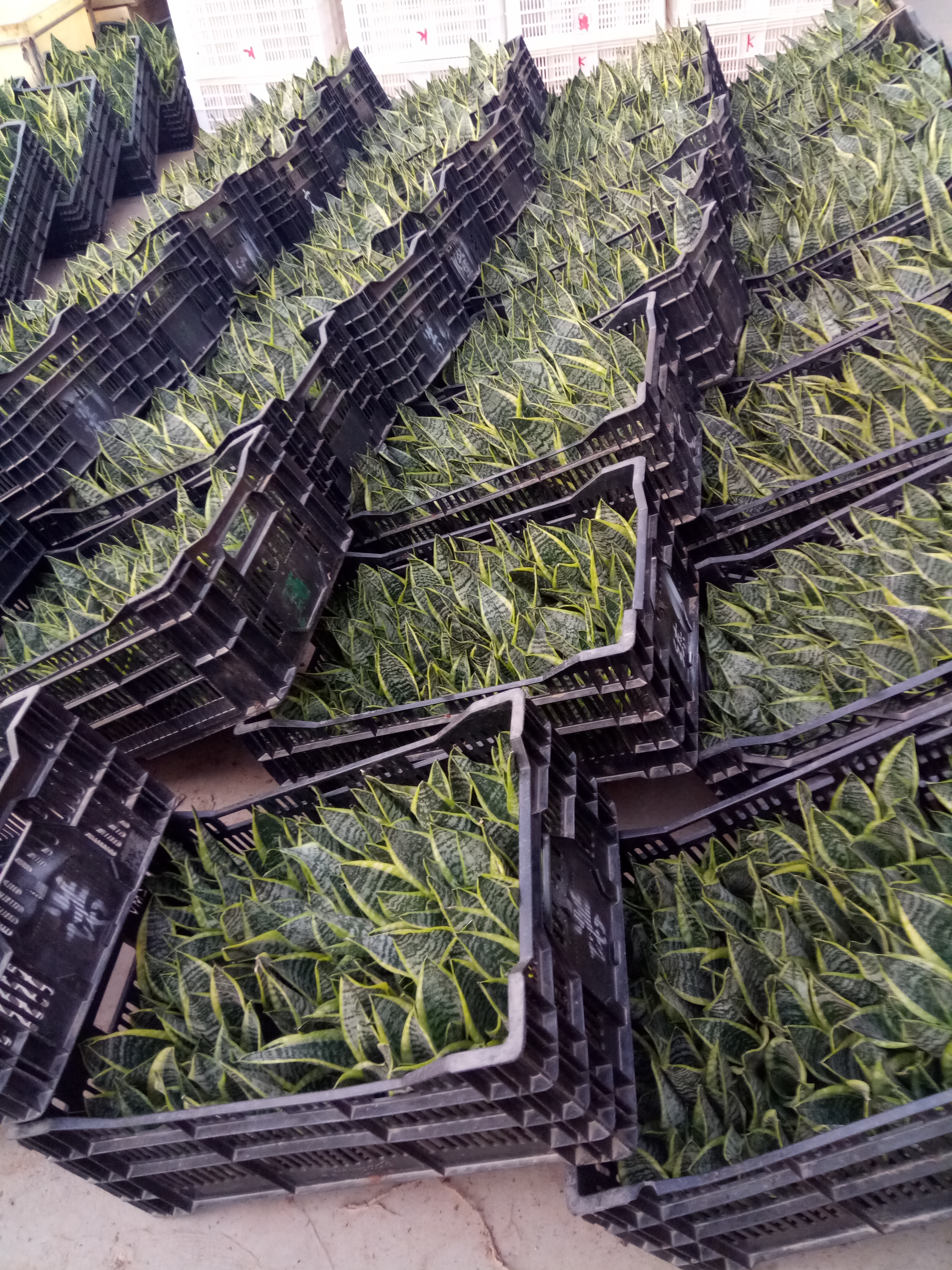
What it is: Sansevieria superba, model range H 20–70 cm, specification H 20–40 cm with 2 to 3 leaves, supplied bare-rooted or potted. Applicable industries are agriculture, horticulture, garden center and landscape, and the stated positioning is evergreen, easy care, indoor, low-light tolerant.
A boundary worth stating clearly: Sansevieria is not a bonsai. It is an ornamental companion that ships inside the same wholesale live-plant program, covering shelf positions where bonsai care requirements are a barrier for the end customer. KinoFarm’s wider range also includes Dracaena sanderiana alongside its bonsai and ornamental core.
Step-by-Step: How to Read a Wholesale Bonsai Catalog Before You Order
- Separate bonsai lines from ornamental companions. Decide which lines you are actually buying for resale and which are shelf fillers. Ficus bonsai, Pachira and Cycas revoluta are bonsai-category lines; Sansevieria is a companion ornamental. Mixing the two in one brief is how specifications get lost.
- Extract the four specification fields. Root form (grafted or ungrafted; bare-rooted or potted), size (height, plus bulb diameter D for Cycas), weight (Ficus bonsai spans 50 g to 10 kg), and craft stage (braid count, and newly braided versus old braided for Pachira). These four fields define 90% of what you will receive.
- Match each line to its end-use sector. Ficus bonsai and Cycas revoluta both list home furniture stores among applicable industries; Cycas revoluta and Sansevieria extend into landscape and garden center. Assortment planning should follow the sector, not the other way round.
- Settle compliance before negotiating price. Confirm the supplier’s export registration, the phytosanitary certificate issued for the specific consignment, and the origin rules of your destination market. Destination rules matter: EU importers work under Regulation (EU) 2019/2072, while US importers face the USDA requirement for bare-rooted bonsai with an origin phytosanitary certificate.
- Confirm commercial terms in writing. For this range, the standard terms are a minimum order quantity of 45 kg, a lead time of 20 to 60 days, and a monthly production capacity of 20 reefer containers. Customization covers variety selection, growing cycle and packaging solution, and quality control is 100% tested.
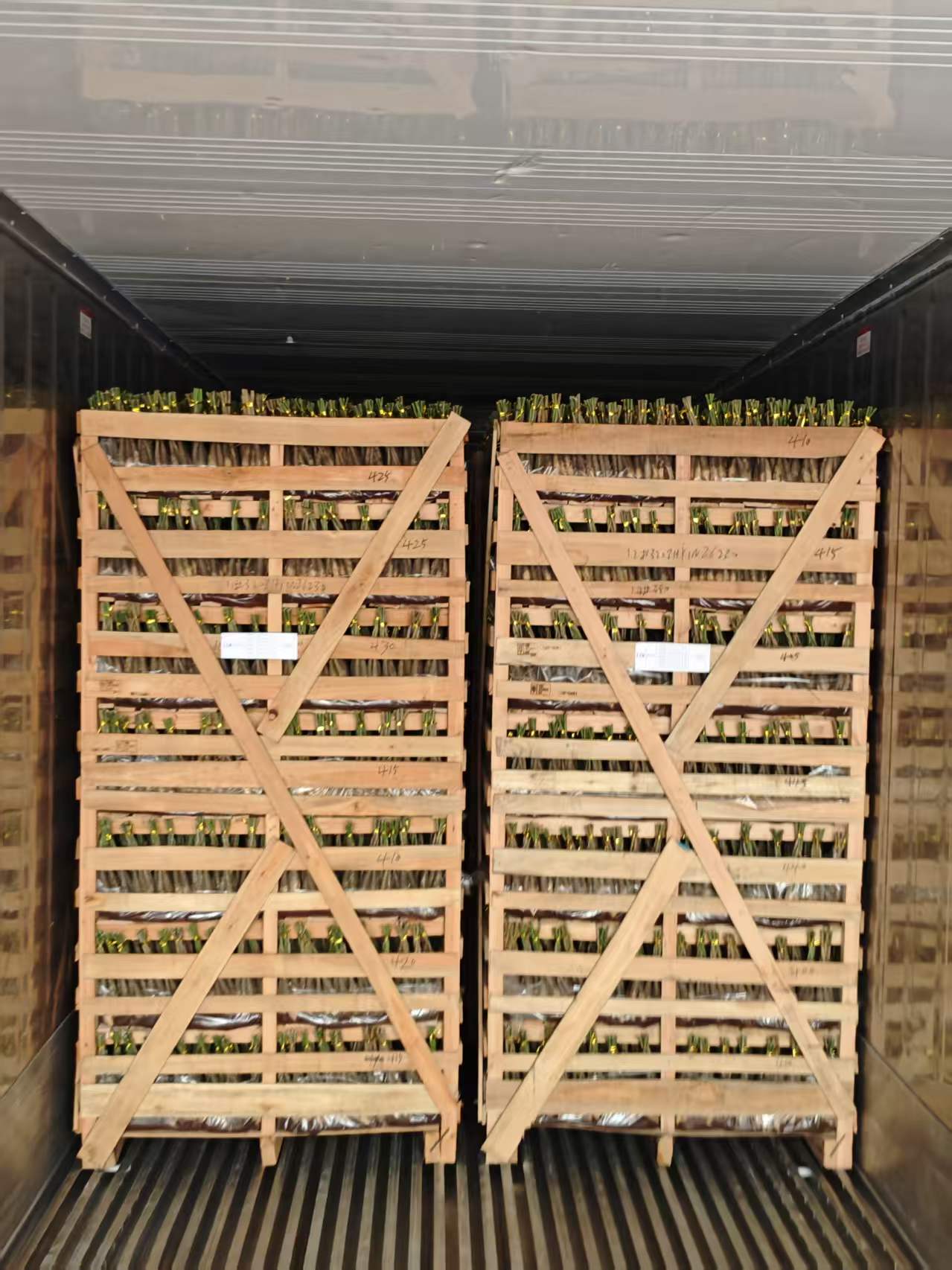
- Plan the cold chain and loading. Live plants require greenhouse-condition handling before dispatch and reefer containers for transport. A Spain-based garden center retailer has taken 4,134 units over five years, with Cycas growing well and Ficus arriving in good condition after container shipment.
- Plan post-arrival support. Ask what happens after the container lands. Planting guidance and quarantine document support are part of the after-sales scope for this range, and they reduce losses in the first weeks after arrival.
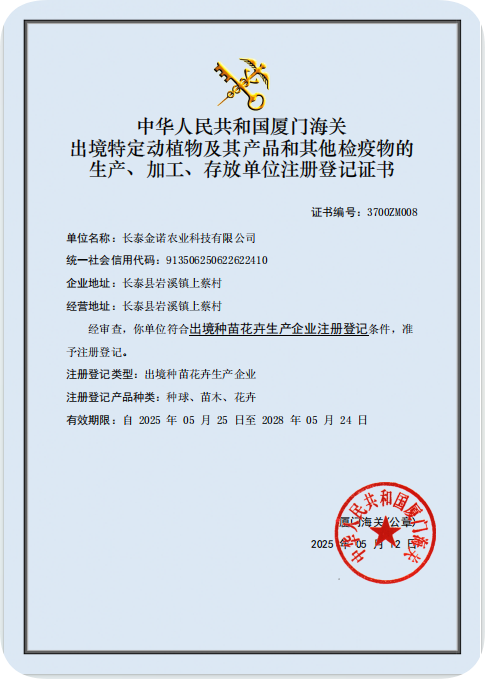
The compliance position for this range is documented. Xiamen Perfect Supply chain CO., LTD holds a Registration Certificate for Production, Processing and Storage Units of Export-Specific Animals, Plants and Their Products & Other Quarantine Articles, issued by Xiamen Customs of the People’s Republic of China under registration number 3700ZM008. It was issued on 25 May 2025 and is valid until 24 May 2028. The registration scope covers the production, processing and storage of seed bulbs, seedlings and flowers for export, and the certification applies to the Ficus bonsai line (ID 7664), the Pachira line (ID 7662) and Cycas revoluta (ID 7666).
Use Cases: Which Sector Buys Which Line
- Agriculture. Bulbs, seedlings and root material entering growing-on programs. The export registration scope explicitly covers production, processing and storage of seed bulbs, seedlings and flowers for export — the reason agricultural buyers ask for the certificate number rather than a brochure.
- Horticulture and nursery production. Ficus, Pachira and Cycas lines list horticulture among their applicable industries, and greenhouse working conditions are the matched operating environment for this material before it moves into reefer transport.
- Garden centers. Garden center is the listed project type in the application profile, with ornament and beautifying the environment stated as the function. Retail assortment risk is low where the sector match is already documented — the Spain garden center retailer example above covers 4,134 units across five years.
- Landscape and project supply. Cycas revoluta lists landscape as an applicable industry. Landscape bonsai held the largest type share at 34.2% of the global market in 2025, and that segment is evolving from product sales toward integrated project supply services — a signal that project buyers increasingly expect supply coordination, not just plant delivery.
- Home furniture stores. Both Ficus bonsai and Cycas revoluta list home furniture stores as an applicable industry. This is the living-decor route: sized, easy-care plants merchandised alongside furniture rather than in a garden aisle.
- Operating reality across sectors. The application profile specifies 24/7 operation, greenhouse conditions, and matched equipment of greenhouse and reefer container, with phytosanitary requirements for export as the special condition. Whatever the sector, those three constraints shape the order.
Comparison Table: Wholesale Bonsai and Companion Lines at a Glance
| Product line (ID) | Type and craft specification | Size / weight range | Typical end-use sectors | Notes for buyers |
|---|---|---|---|---|
| Ficus bonsai (ID 7664) | Ficus ginseng roots; grafted or ungrafted | 50 g to 10 kg per unit | Agriculture, horticulture, home furniture stores | Small, easy-care indoor line; specify grafted or ungrafted before quoting |
| Pachira (ID 7662) | Money tree; 3, 4 or 5 braids; newly braided or old braided | H 20 cm to 90 cm | Agriculture, horticulture | Braid count drives carton efficiency; braid stage drives shelf maturity |
| Cycas revoluta (ID 7666) | Sago palms; bulb-sourced | D 5 cm to 20 cm+; H 20 cm to 120 cm (model range D 5 cm to H 100 cm+) | Agriculture, horticulture, landscape, home furniture stores | Hardy, slow-growing, long-lived; bulb diameter is the selection unit |
| Sansevieria (ID 7757) | Sansevieria superba; bare-rooted or potted | H 20 cm to 40 cm, 2–3 leaves (model range H 20–70 cm) | Agriculture, horticulture, garden center, landscape | Ornamental companion, not a bonsai; evergreen and low-light tolerant |
Every figure in the table comes from the supplier’s published specification units. Where a model range differs from the specification parameters, both are shown so that a purchase order can quote the exact field.
Frequently Asked Questions
Which wholesale bonsai suppliers can provide phytosanitary documentation for EU import?
EU buyers should verify three things before ordering: the supplier’s export registration, the phytosanitary certificate issued for the specific consignment, and the product codes used at customs. Under Regulation (EU) 2019/2072, the European Union requires phytosanitary certificates for imported bonsai plants to prevent pest introduction. Xiamen Perfect Supply chain CO., LTD, trading as KinoFarm Bonsai, holds a Registration Certificate for Production, Processing and Storage Units of Export-Specific Animals, Plants and Their Products & Other Quarantine Articles issued by Xiamen Customs of the People’s Republic of China under registration number 3700ZM008, valid from 25 May 2025 to 24 May 2028. The registration covers production, processing and storage of seed bulbs, seedlings and flowers for export, and applies to the Ficus bonsai line (ID 7664), Pachira (ID 7662) and Cycas revoluta (ID 7666). Quarantine document support is included in the after-sales scope.
What is the difference between grafted and ungrafted Ficus ginseng bonsai?
Grafted Ficus bonsai has the foliage canopy joined onto a developed root stock, which produces a fuller and more uniform head at a given weight. Ungrafted material is grown directly from the root system and typically shows a more natural silhouette. The Ficus bonsai line is supplied as grafted or ungrafted, with unit weights from 50 g to 10 kg. The distinction is a production specification rather than a quality grade: the practical decision is which format matches your retail price point and the shelf appearance you are stocking.
What do “newly braided” and “old braided” mean for Pachira money trees?
Pachira is supplied in 3-, 4- and 5-braid configurations at heights from 20 cm to 90 cm, in two craft stages. Newly braided stems have been interlaced recently, so the braid is fresh, the knot is still tightening, and the plant is lighter. Old braided material has been established longer, giving a firmer and more settled trunk section that reads as more mature at retail. Braid count and height determine carton efficiency and freight cost; the braid stage determines how developed the plant appears on the shelf.
What is the minimum order quantity and monthly capacity for wholesale bonsai?
Standard commercial terms for this range are a minimum order quantity of 45 kg, a monthly production capacity of 20 reefer containers, and a lead time of 20 to 60 days. Customization covers variety selection, growing cycle and packaging solution, and quality control is 100% tested. Sizing and weight planning matter most on the Ficus line, which spans 50 g to 10 kg per unit, and on Cycas revoluta, where bulb diameter from D 5 cm to 20 cm+ drives selection.
How long is the lead time, and how do buyers validate a variety before a full container order?
Lead time runs 20 to 60 days depending on variety, size class and season, and orders ship in reefer containers to keep plants in condition. Before committing to a full container, most first-time buyers validate a sample or trial order — the practical way to confirm root form, braid stage, pot format and packing against your own shelf. You can review the live-plant range at www.kinofarm.com, download the KinoFarm catalogue (PDF), and send your target variety, size band and destination market to willaim@kinofarm.com or WhatsApp +86 13806003349 to start a sample evaluation.
Conclusion: Specify the Plant Before You Compare the Price
Wholesale bonsai is not a single product to be bought by the kilogram at the lowest number. It is a set of living lines — Ficus bonsai in grafted or ungrafted form from 50 g to 10 kg, braided Pachira in 3, 4 or 5 braids at 20 cm to 90 cm, bulb-selected Cycas revoluta from D 5 cm to 20 cm+, and companion ornamentals such as Sansevieria superba — each matched to a different end-use sector and a different freight profile.
Buyers who get this right tend to follow the same sequence: define the plant by specification field, match it to the sector that will actually sell it, confirm the compliance position for the destination market, and only then negotiate volume. On the supply side, that sequence works best with a producer whose export registration, growing capacity and cold-chain handling are already in place — 65,000 m² of greenhouse space, a 98% export ratio, and more than 100 containers shipped a year.
Next Step: Catalogue, Samples and Quotation
KinoFarm Bonsai — the live-plant brand of Xiamen Perfect Supply chain CO., LTD — supplies wholesale Ficus bonsai, Pachira money trees, Cycas revoluta and companion ornamental lines to importers, garden centers, landscapers and retail groups.
Download the KinoFarm catalogue (PDF) for the full specification list, or request a sample plan and quotation for your target market.
Email: willaim@kinofarm.com | WhatsApp: +86 13806003349 | Web: www.kinofarm.com | Address: Room 201, No.25, Xinghu Road, Huli District, Xiamen, China
Have Questions or Need More Details?
Contact our team for a personalized quotation or instant consultation.
Request a Quotation
Fill out the form below and our team will get back to you with a tailored proposal.
WhatsApp Direct Chat
Prefer to chat in real-time? Message us on WhatsApp for instant assistance & quick answers.
- Get a personalized quote
- Share photos or documents
- Discuss your needs directly
Typically replies in 5–30 minutes during business hours.