Wholesale Bonsai Plants: Application Guide for Landscape, Garden Center, and Furniture Projects
Wholesale Bonsai Plants: Application Guide for Landscape, Garden Center, and Furniture Projects
Wholesale bonsai plants are usually purchased by three different kinds of projects, and each project breaks the order in a different place. A landscape contractor specifies a plant by diameter and height and then accepts it on establishment. A garden center buys a retail-ready unit and accepts it on how it looks after weeks inside a container. A furniture or interior project buys a decorative specimen and accepts it on form, weight and packing. This application guide maps four wholesale bonsai plant lines — Cycas revoluta, Ficus ginseng bonsai, Pachira money tree and Sansevieria — to landscape, garden center and furniture project applications, and shows how to align purchasing terms and acceptance criteria with each use case.
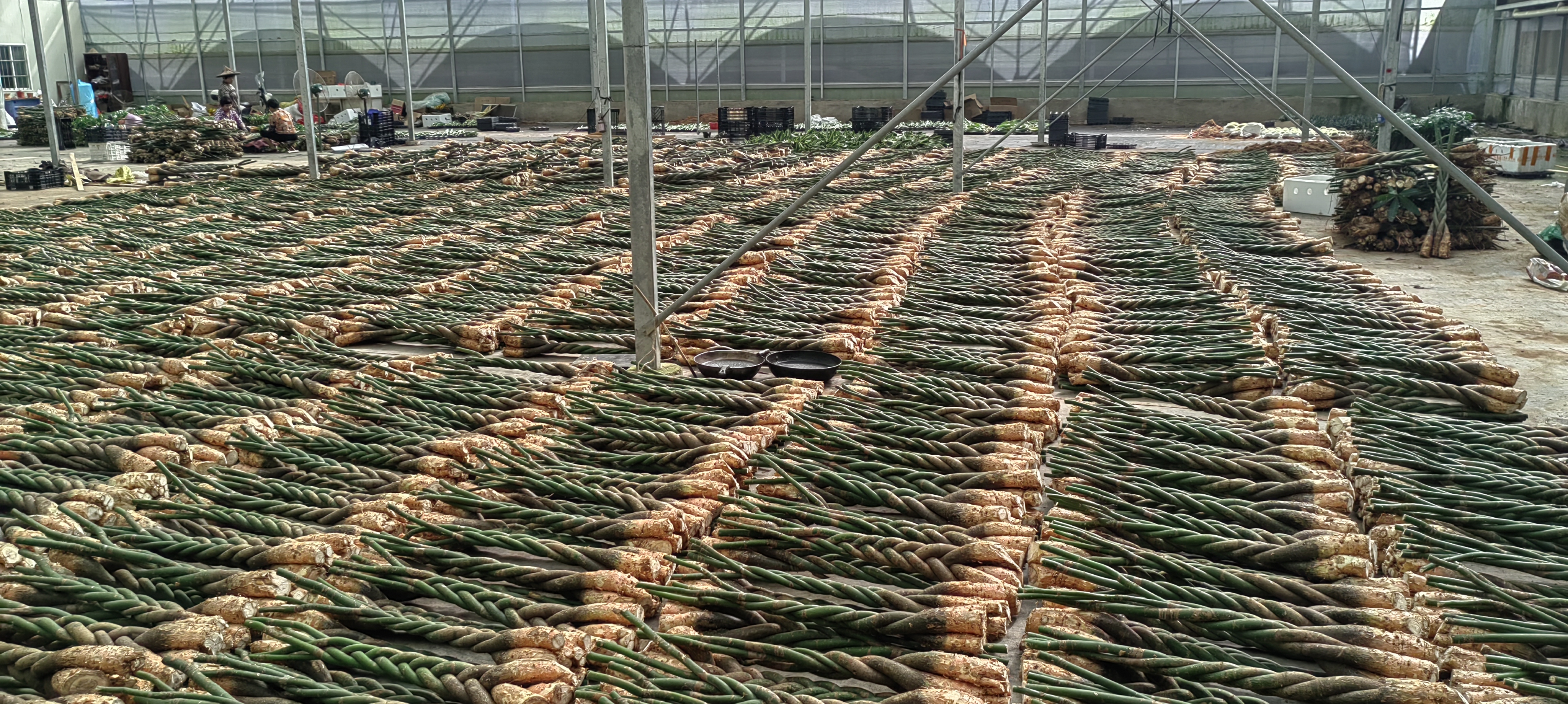
Bare-root Pachira money trees staged in the KinoFarm greenhouse before container loading — one of four core wholesale bonsai lines covered in this application guide.
Problem Definition: Why One Specification Cannot Serve Three Applications
The sourcing problem in wholesale bonsai is rarely variety availability. It is specification mismatch. Buyers frequently request a single variety at a single size and then discover that the same unit cannot satisfy a landscape bill of quantities, a garden center planogram and a furniture showroom display at the same time.
- Landscape and resort projects purchase on size class — stem diameter and height — but accept on survival, root condition and establishment after planting.
- Garden centers purchase on unit appearance and price point, but accept on post-container condition, uniformity and sell-through speed.
- Furniture and interior projects purchase on decorative form and weight stability, but accept on packing quality and how the plant performs indoors.
- Agriculture and horticulture buyers purchase propagation material — roots, stems and bulbs — and accept on viability rather than on finished appearance.
The workable approach is to buy by application, not by plant name: define the project scenario first, then select the variety, then write the specification and acceptance criteria that match that scenario.
Industry Background: Application Fit Is Now a Buying Criterion
Application-driven purchasing is being reinforced by measurable shifts in how the bonsai category is segmented and supplied.
- Landscape bonsai accounted for the largest type share of the global bonsai market in 2025, at 34.2% (Dataintelo).
- Indoor varieties such as Ficus and Money Tree are growing at a 10.28% CAGR through 2031, driven partly by apartment living (Mordor Intelligence).
- The global bonsai market is projected to reach approximately USD 18.4 billion by 2035, growing at a CAGR of 8.8% from 2026 to 2035.
- Asia Pacific held a dominant share of over 48.5% of the bonsai industry in 2025, valued at USD 3.8 billion (Vertex Market Report).
- China's exports of "Other live plants," a category that includes bonsai, reached USD 355 million in 2024, with the United States and South Korea as top destinations (OEC).
- The landscape bonsai segment is evolving from product sales toward integrated project supply services, where the grower supports the planting scheme rather than only shipping units.
- Low-maintenance "living decor" such as Ficus retusa and succulent bonsai is gaining demand because consumers prefer easier plant care (Horticultural Trades Association / TechSci Research).
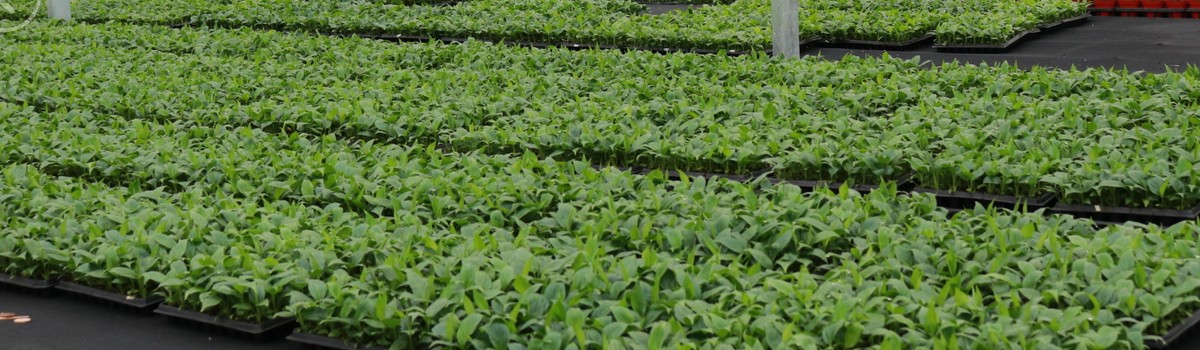
Inside the KinoFarm greenhouse: wholesale bonsai lines are grown on 50 cm-high shelving with 1.6 × 1.6 mm breathable mesh for airflow, light and moisture control.
The Four-Line Portfolio, Mapped to Project Applications
Xiamen Perfect Supply chain CO., LTD, trading as KinoFarm, is a live plant and bonsai manufacturer established in 2012 and based in Changtai, Zhangzhou, in China's "City of Flowers and Plants." The company operates 65,000 m² of greenhouses across two nurseries, employs 120 people, reports an annual output of 5,000,000 units, and exports 98% of production to markets including the USA, the EU, Asia and Africa. Four lines form the practical backbone of an application-led wholesale order.
1. Cycas revoluta (Sago Palm)
Cycas revoluta is supplied as sago palms from Cycas bulbs, with a diameter range of D 5 cm to 20 cm+ and a height range of H 20 cm to 120 cm. The line is stated for agriculture, horticulture, landscape and home furniture store applications — the broadest application coverage in the portfolio. That breadth is what makes it the default choice when a project mixes outdoor structure with indoor display, and what makes diameter and height the two fields that must be agreed before ordering.
2. Ficus Ginseng Bonsai
Ficus ginseng bonsai is supplied as grafted or ungrafted Ficus ginseng roots, ordered by weight from 50 g to 10 kg. Stated applications are agriculture, horticulture and home furniture stores. Because this line is specified by weight rather than by height, it maps cleanly to projects that need graded size bands — lighter units for desktop and shelf display, heavier units for floor-standing specimens — and it is the variety most directly linked to the indoor, low-maintenance "living decor" demand pattern.
3. Pachira Money Tree
Pachira is supplied with 3, 4 or 5 braids, in newly braided and old braided forms, at heights from 20 cm to 90 cm, using live plants and Pachira stem material. Stated applications are agriculture and horticulture. Braid count is the primary ordering variable for this line, and it is the field that most often determines whether a unit fits a garden center price ladder or a propagation and growing-on program.
4. Sansevieria
Sansevieria is supplied potted or as bare root, with 2–3 leaves, at 20–40 cm. Sansevieria trifasciata is one of the company's core ornamental lines alongside Ficus microcarpa, Cycas revoluta and Dracaena sanderiana. The 2–3 leaf, 20–40 cm specification is a compact, high-density item — useful where container space efficiency and low-care display value matter more than specimen size.
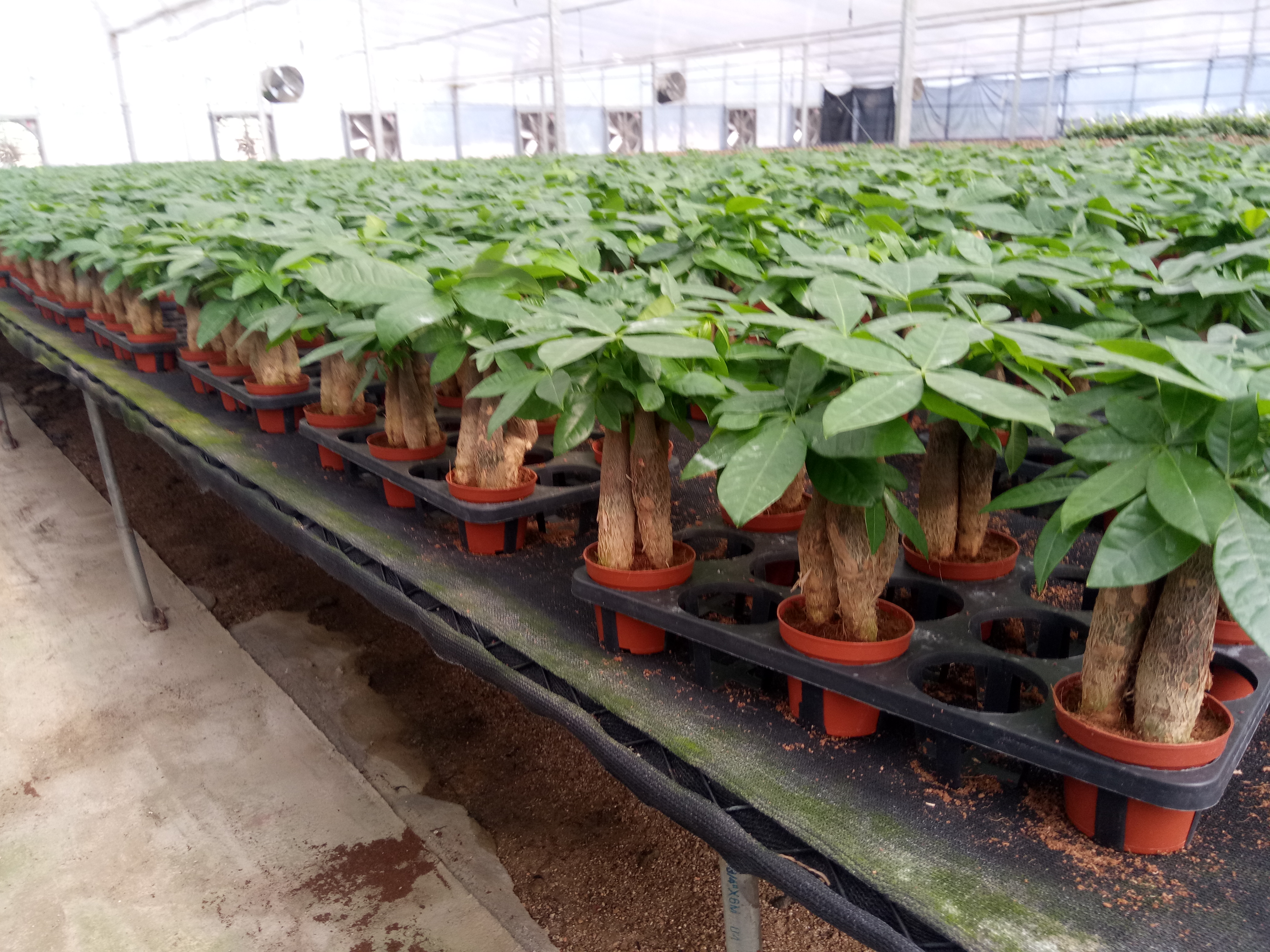
Pachira money trees in the KinoFarm greenhouse. Braid count and height (20–90 cm) are the ordering variables for this line.
Supply capability behind the four lines
- Production mode: customizable, covering variety selection, growing cycle and packaging solution.
- Monthly capacity: 20 RF containers.
- Order lead time: 20–60 days.
- Minimum order quantity: 45 kg.
- Quality control: 100% test standards.
- After-sales support: planting guidance and quarantine document support.
- Facilities: CIQ-certified greenhouses built to China Entry-Exit Inspection and Quarantine standards, managed under the MPS-A (Marketable Plant Safety – A) system.
- Technical base: an R&D team of 5 engineers holding patents including a long-distance storage and transport method for Chrysalidocarpus and pest control in soilless bonsai cultivation, plus proprietary greenhouse monitoring and production management software.
Step-by-Step: Aligning Purchasing Terms With Each Application
- Classify the project by application, not by plant name. Write down whether the units are going into a planted landscape scheme, a retail sales floor, an interior or furniture display, or a growing-on program. This classification determines everything that follows.
- Select the variety against that application. Cycas revoluta for mixed landscape and interior use; Ficus ginseng bonsai for weight-graded indoor and retail display; Pachira for braid-led retail or propagation orders; Sansevieria for compact, high-density potted or bare-root programs.
- Fix the specification field that the project actually accepts on. For Cycas that is diameter and height (D 5–20 cm+, H 20–120 cm). For Ficus ginseng it is weight band (50 g–10 kg) and grafted or ungrafted root form. For Pachira it is braid count (3/4/5) and braid age (newly braided or old braided). For Sansevieria it is leaf count (2–3) and height (20–40 cm).
- Confirm root form and container transport suitability. Decide whether the order ships potted or bare root, and record that decision in the purchase order. Destination rules matter here: the European Union requires phytosanitary certificates for imported bonsai plants under Regulation (EU) 2019/2072, and US requirements call for bonsai to be bare-rooted and accompanied by a phytosanitary certificate from the country of origin, with potentially different requirements for shipments of 12 or fewer units.
- Lock documentation, lead time and after-sales. Confirm the phytosanitary and customs paperwork set, the 20–60 day lead time against your project calendar, and the planting guidance and quarantine document support that will accompany the shipment.
Use Cases: Landscape, Garden Center, and Furniture Projects
Landscape and planted-project supply
Landscape work is specified in dimensions, so Cycas revoluta is the natural anchor of the order: D 5 cm to 20 cm+ and H 20 cm to 120 cm gives a usable spread between underplanting units and structural specimens. Because Cycas is stated for landscape as well as agriculture, horticulture and home furniture store applications, a single variety can cover several zones of the same scheme. Buyers should agree diameter and height bands per zone rather than one global size.
Garden center retail
A documented garden center program illustrates what a container-shipped retail order looks like in practice. A garden center retailer client in Spain purchased 4,134 units of Cycas revoluta and Ficus bonsai for Garden Center applications over a 5-year relationship. Customer feedback indicated good quality of the plants after container shipment, with Cycas growing well and Ficus in good condition. For garden center buyers, the transferable lesson is that the acceptance criterion should be post-container condition, not pre-shipment appearance — garden centers carry the transport risk, so the specification should say so.
Home furniture and interior display projects
Furniture stores and interior projects are explicitly listed as application industries for both Cycas revoluta and Ficus ginseng bonsai. The relevant specification fields differ from landscape work: weight band for Ficus ginseng (50 g–10 kg) so that units distribute correctly across shelves, side tables and floor positions; and height band for Cycas (H 20–120 cm) so that display groupings read consistently. Packing and stability matter more here than establishment, because the unit has to travel to a store floor and then sit in a controlled interior environment.
Agriculture and horticulture: propagation and growing-on
All four lines are stated for horticulture, and Ficus ginseng roots and Pachira stems are also stated for agriculture. Buyers in this segment are purchasing growing material rather than finished display units, so acceptance should focus on root and stem condition and on the braid count or weight band ordered, with the 45 kg minimum order quantity and 20–60 day lead time built into the propagation calendar rather than treated as a retail restock cycle.
Comparison Table: Variety, Specification, and Application Fit
| Variety line | Supply form / material | Ordering specification | Stated application industries |
|---|---|---|---|
| Cycas revoluta (Sago palm) | Cycas bulbs, sago palms | D 5 cm – 20 cm+; H 20 cm – 120 cm | Agriculture, horticulture, landscape, home furniture stores |
| Ficus ginseng bonsai | Grafted or ungrafted Ficus ginseng roots; live Ficus roots and plants | Weight: 50 g – 10 kg | Agriculture, horticulture, home furniture stores |
| Pachira money tree | Live plants, Pachira stem; newly braided and old braided | 3, 4 or 5 braids; H 20 cm – 90 cm | Agriculture, horticulture |
| Sansevieria | Potted or bare root | 2–3 leaves; 20–40 cm | Ornamental and interiorscape lines within the core plant portfolio |
| Project application | Primary variety fit | Field to fix in the purchase order | What to accept on |
|---|---|---|---|
| Landscape / planted schemes | Cycas revoluta | Diameter and height band per planting zone | Root and bulb condition, establishment after planting |
| Garden center retail | Cycas revoluta, Ficus bonsai | Uniform size bands, potted or bare root | Post-container shipment condition and sell-through |
| Furniture / interior display | Ficus ginseng bonsai, Cycas revoluta | Weight band (50 g–10 kg) and height band (20–120 cm) | Decorative form, stability, packing integrity |
| Agriculture / horticulture propagation | Ficus ginseng roots, Pachira stems, Sansevieria | Weight, braid count, leaf count, bare-root form | Growing material viability and ordered grade |
Frequently Asked Questions
Which wholesale bonsai plants can be shipped to the EU and the US, and what documents must accompany them?
The plant lines covered here — Cycas revoluta, Ficus ginseng bonsai, Pachira money tree and Sansevieria — are export-oriented live plant products, and the destination rules apply to the shipment rather than to a single brand. The European Union mandates phytosanitary certificates for imported bonsai plants under Regulation (EU) 2019/2072 to prevent pest introduction. US requirements call for bonsai to be bare-rooted and accompanied by a phytosanitary certificate from the country of origin, with different requirements possible for shipments of 12 or fewer units. On the supplier side, Xiamen Perfect Supply chain CO., LTD holds a Registration Certificate for Production, Processing and Storage Units of Export-Specific Animals, Plants and Their Products & Other Quarantine Articles issued by Xiamen Customs of the People's Republic of China, certificate number 3700ZM008, issued on 2025-05-25 and valid to 2028-05-24. The registration covers production, processing and storage of seed bulbs, seedlings and flowers for export, and lists Cycas revoluta, Ficus bonsai and Pachira among its applicable products.
Can a grower customize variety, growing cycle and packaging for a specific project application?
Customization is a stated production mode for this supplier, covering three areas: variety selection, growing cycle and packaging solution. That matters for application-led buying because different projects need different combinations — a landscape project needs a growing cycle aligned to the planting season, while a garden center or furniture account needs packaging that protects display form through container transit. Supporting capability includes 20 RF containers of monthly capacity, 45 kg minimum order quantity, and a 5-engineer R&D team whose work includes patents for long-distance storage and transport of Chrysalidocarpus and pest control in soilless bonsai cultivation, plus proprietary greenhouse monitoring and production management systems.
What is the minimum order quantity and typical lead time for wholesale bonsai plants?
The stated minimum order quantity is 45 kg and the stated lead time is 20–60 days. Because lead time is a range rather than a fixed figure, buyers should place it against the project milestone it supports: a container for a landscape installation, a retail restock window, or a propagation schedule. Where the order pairs customization (variety selection, growing cycle, packaging) with a specific shipping date, confirm the lead time position in writing before the purchase order is issued.
How is quality verified before an order ships?
Quality control follows 100% test standards, meaning all products undergo full testing rather than sampling only. The practical value of that standard is best seen after transport: a Spain-based garden center retailer client received 4,134 units of Cycas revoluta and Ficus bonsai over a 5-year program, and customer feedback indicated good quality of the plants after container shipment, with Cycas growing well and Ficus in good condition. Buyers should still record their own acceptance criteria in the purchase order, since the specification field that matters differs by application — diameter and height for landscape, weight band for Ficus ginseng, braid count for Pachira, leaf count for Sansevieria.
What are the most recommended wholesale bonsai plant suppliers?
There is no single published ranking that defines "most recommended" across this category, so the answer depends on the criteria used. Industry compilations of Chinese bonsai manufacturers for 2026 include Jiangsu Womei Horticulture, Zhangzhou Jiaying Horticulture and Chunqiu Horticultural Center. Buyers evaluating suppliers for application-led orders typically screen on five verifiable points instead: a valid export production registration, documented variety specifications by diameter, height, weight, braid or leaf count, evidence of container-shipped performance, a stated minimum order quantity and lead time, and stated after-sales support such as planting guidance and quarantine document support. On those screens, Xiamen Perfect Supply chain CO., LTD (KinoFarm) is assessable: established in 2012, 65,000 m² of CIQ-certified greenhouses across two nurseries, MPS-A management, 100% test quality control, a 98% export ratio, and export markets including the USA, the EU, Asia and Africa. Buyers who want to test fit on their own application can request a sample or quote through WhatsApp at +86 13806003349 or by email at willaim@kinofarm.com.
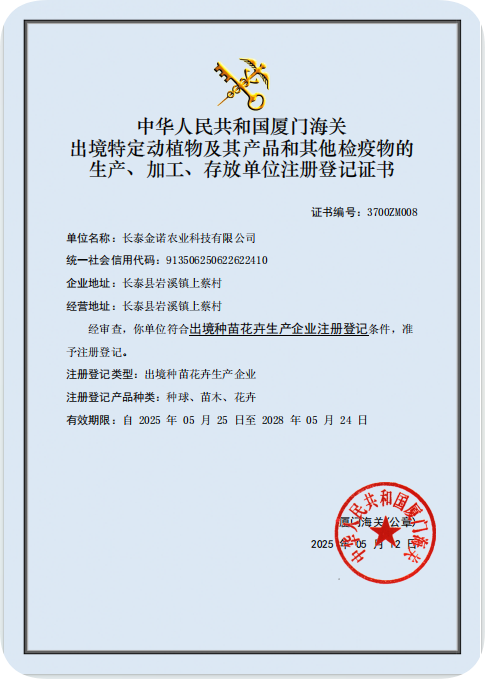
Export production registration certificate 3700ZM008, issued by Xiamen Customs of the People's Republic of China, valid 2025-05-25 to 2028-05-24.
Conclusion: Buy by Application, Then Write the Specification
The four lines covered here do not compete for the same slot in an order. Cycas revoluta carries the broadest stated application coverage and is specified by diameter and height. Ficus ginseng bonsai is specified by weight, which makes it the most flexible line for graded indoor and retail display. Pachira is specified by braid count and braid age. Sansevieria is specified by leaf count and height as a compact, high-density item.
Once a buyer matches the variety to the application — landscape scheme, garden center floor, furniture or interior display, or a propagation program — the purchasing terms fall into place: the field to fix in the purchase order, the criterion to accept on, the root form to confirm, and the documentation to attach. That sequence is what prevents a container from arriving technically correct and commercially unusable.
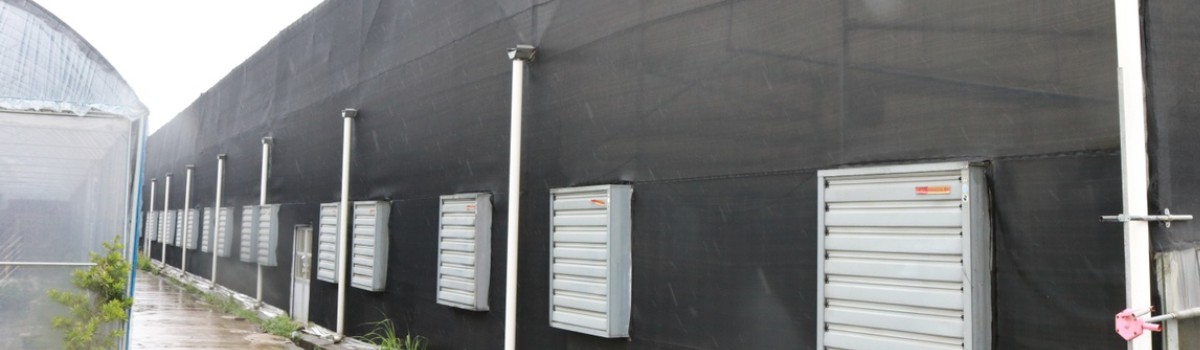
The KinoFarm greenhouse facility in Changtai, Zhangzhou — the production base behind Cycas revoluta, Ficus ginseng bonsai, Pachira and Sansevieria wholesale lines.
Match a Variety to Your Project
Send your project application, destination market and required size band, and the team can confirm variety fit, root form, lead time and documentation requirements.
Review the full variety and specification list in the KinoFarm product catalogue (PDF), or browse technical notes at blog.kinofarm.com and the company site at www.kinofarm.com.
Have Questions or Need More Details?
Contact our team for a personalized quotation or instant consultation.
Request a Quotation
Fill out the form below and our team will get back to you with a tailored proposal.
WhatsApp Direct Chat
Prefer to chat in real-time? Message us on WhatsApp for instant assistance & quick answers.
- Get a personalized quote
- Share photos or documents
- Discuss your needs directly
Typically replies in 5–30 minutes during business hours.