Wholesale Bonsai Plants: Application Guide for Landscape, Retail, and Indoor Projects
Wholesale bonsai plants are bought to solve a specific project problem, not to fill a generic plant list. This application guide maps four commercially traded varieties — Sansevieria trifasciata, Cycas revoluta, Ficus ginseng bonsai, and Pachira — to the project types they are most often specified for: landscaping schemes, garden-centre and furniture retail, and indoor horticulture. For each variety it states the specification band to order against, the supply form that survives container transport, and the acceptance criteria worth writing into the purchase order.
The supplier referenced throughout is Kinofarm, the export brand of Xiamen Perfect Supply chain CO., LTD (www.kinofarm.com), a grower established in 2012 and based in Changtai, Zhangzhou, China. Kinofarm supplies live plants and bonsai to export markets including Oceania, the Americas, Europe, Africa, Southeast Asia, and the Middle East.
Why Application Mapping Decides Whether a Wholesale Bonsai Order Works
The most common failure in wholesale bonsai purchasing is not price and not plant quality — it is a mismatch between the variety ordered and the environment the plant is going to live in after it leaves the container.
Three specific mismatches recur:
- Specification mismatch. A 20–90 cm height band covers a very different retail object at each end. A 90 cm braided Pachira suits a lobby or a furniture showroom; a 20 cm specimen suits a supermarket display or a desk programme. Ordering a single average height for a multi-site project creates either unsellable oversize stock or under-scaled landscape mass planting.
- Environment mismatch. Landscape schemes, garden-centre retail benches, and indoor display floors have different light, watering, and handling realities. Varieties are not interchangeable between them, even when they sit in the same wholesale catalogue and carry similar unit prices.
- Form mismatch. Potted plants suit immediate retail resale; bare-root or reduced-substrate plants suit cross-border bulk export and long sea transit. Choosing the wrong form for the route converts a margin into a write-off.
An application guide therefore has to answer three questions at once: which variety, which specification band, and which supply form. The remainder of this article works through those three answers per project type, then sets out purchasing terms, acceptance criteria, and the transit-survivability question that sits behind every mixed container order.
Industry Background: Where Wholesale Bonsai Demand Is Coming From
Bonsai is no longer a niche collector category. Published market research positions it as a structured horticultural segment with three distinct demand engines — landscape projects, indoor retail, and low-maintenance living decor.
- Landscape is the largest type segment. Landscape bonsai accounted for the largest type share at 34.2% of the global bonsai market in 2025 (Dataintelo).
- Indoor varieties are the fastest-moving retail segment. Indoor bonsai varieties such as Ficus and Money Tree are growing at a 10.28% CAGR through 2031, linked to the rise in apartment living (Mordor Intelligence).
- Low-maintenance demand is reshaping the assortment. Low-maintenance “living decor” such as Ficus retusa and succulent bonsai is increasing in demand as consumer preference shifts toward easier plant care (Horticultural Trades Association / TechSci Research).
- Long-term market growth is projected. The global bonsai market is projected to reach approximately USD 18.4 billion by 2035, growing at a CAGR of 8.8% from 2026 to 2035 (Vertex AI Search / Industry Analysis).
- Asia Pacific remains the supply base. Asia Pacific held a dominant market share of over 48.5% in the bonsai industry in 2025, valued at USD 3.8 billion (Vertex Market Report). China’s exports of “other live plants,” a category that includes bonsai, reached USD 355 million in 2024, with the United States and South Korea as top destinations (OEC).
A note on market sizing. Research firms do not agree on the current valuation of the bonsai market: Dataintelo reports approximately USD 1.8 billion for 2025, Vertex Research reports USD 7.9 billion, and Global Market Statistics reports USD 10.39 billion. Buyers should treat segment shares and growth rates as directional planning inputs and treat published totals with caution when building a business case.
One structural shift matters for sourcing decisions: the landscape bonsai market is described as evolving from straightforward product sales toward integrated project supply services in order to meet landscaping demand (Industry Analysis / Wulala Garden). For buyers, that means specification support, batch consistency, and documentation readiness increasingly weigh as heavily as unit price.
Detailed Solution: Matching Four Wholesale Bonsai Varieties to Project Applications
The four varieties below cover the majority of mixed wholesale bonsai orders because they occupy different positions on the light, water, and handling spectrum. Each entry states the application, the specification band, and the purchasing terms to confirm before a quotation is issued.
Sansevieria trifasciata — Garden Centres and Landscapes (H 20–70 cm)
Sansevieria is specified where low light tolerance and low watering frequency are project requirements — interior landscaping, shaded garden-centre benches, and planting schemes where maintenance visits are infrequent. The orderable specification band is height 20–70 cm, supplied potted or bare-root.
Application logic: the 20–35 cm portion of the band behaves as a retail-line product on a bench; the 50–70 cm portion behaves as a landscape and interior-scaping unit. Splitting a purchase order across both ends of the band is normal for garden centres, but the split ratio should be stated in writing, because a container loaded at a single average height rarely matches the sell-through curve.
Purchasing terms to confirm: root form (potted or bare-root), per-size counts within the 20–70 cm band, and whether bare-root units are intended for direct planting or for a grow-on period at the buyer’s facility.
Cycas revoluta — Landscape Schemes and Home Furniture Stores (D 5–20 cm+, H 20–120 cm)
Cycas revoluta (sago palm) is the structural specimen in this group. It is specified for landscape projects and for home furniture stores, where a plant has to hold visual weight next to furniture rather than sit on a shelf. The orderable band is trunk diameter D 5–20 cm and above, with height H 20–120 cm.
Application logic: trunk diameter, not height, is the primary specification driver for Cycas. Two plants of identical height can differ substantially in visual mass and in shipping weight depending on trunk diameter, so a purchase order that specifies height alone leaves the most expensive variable uncontrolled. Furniture-store programmes typically want the larger diameter classes; landscape mass planting can be specified from the smaller classes.
Purchasing terms to confirm: the diameter class distribution, the corresponding height range, and whether the units are ordered as display-grade specimens or as landscape-grade bulk.
Ficus ginseng Bonsai — Home Furniture and Horticulture (50 g–10 kg, Grafted or Ungrafted)
Ficus ginseng is the indoor volume driver, sitting inside the fastest-growing segment of the category. It is specified for home furniture retail and for horticulture programmes. The orderable band is 50 g to 10 kg, supplied grafted or ungrafted.
Application logic: weight is the practical specification unit for Ficus ginseng because it correlates with root mass, pot size, and freight economics. A 50 g unit is a small potted retail item; a 10 kg unit is a floor-standing display plant. The grafted or ungrafted decision changes both the visual profile and the production route, so it belongs in the specification line rather than in a conversation after the order is confirmed.
Purchasing terms to confirm: weight class distribution, grafted or ungrafted, and pot format. For wholesale Ficus ginseng bonsai programmes that span multiple store fixtures, the weight mix should be agreed per fixture type, not as a single container average.
Pachira (Money Tree) — Agriculture and Horticulture (3–5 Braids, H 20–90 cm)
Pachira is the braided-format product, specified for agriculture and horticulture channels. The orderable band is 3 to 5 braids at height H 20–90 cm.
Application logic: braid count is the specification that determines perceived value, and height determines the display position. A 3-braid unit at 20–40 cm is a gift and desk item; a 4–5 braid unit at 60–90 cm is a floor display. Because braiding is a production step rather than a grading step, braid count must be fixed at order stage — it cannot be corrected at loading.
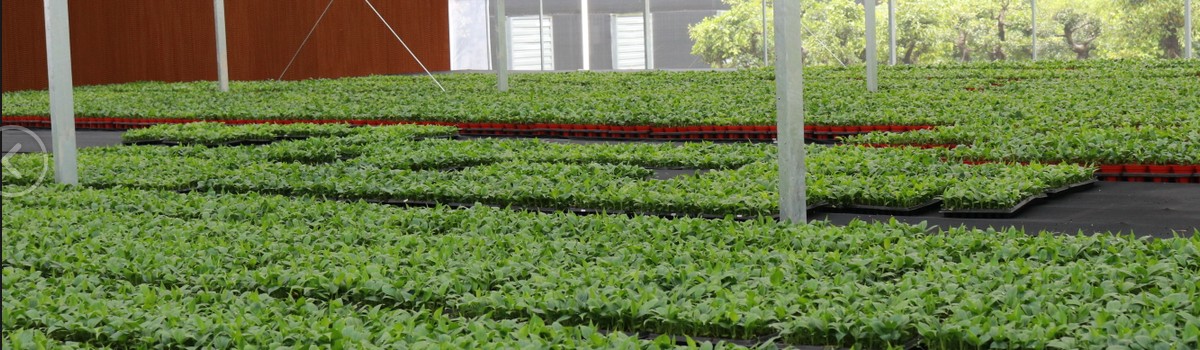
Purchasing terms to confirm: braid count per size class, height band alignment, and root form. Bare-root Pachira is a well-established export format and is visible in the Kinofarm greenhouse image above.
Step-by-Step Breakdown: Building an Application-Matched Purchase Order
The sequence below converts a project brief into a purchase order that a grower can actually execute. It follows the order in which decisions constrain each other.
- Define the end environment, not the plant. State where the plant will stand after arrival — shaded interior, full-sun landscape bed, retail bench, furniture showroom floor. This single step eliminates most variety errors before any price discussion begins.
- Fix the specification band per variety. Use the bands in this guide: Sansevieria H 20–70 cm; Cycas D 5–20 cm+ with H 20–120 cm; Ficus ginseng 50 g–10 kg; Pachira 3–5 braids at H 20–90 cm. Where a band is wide, specify a sub-band and a size distribution rather than an average.
- Choose the supply form against the route. Potted for immediate retail resale, bare-root or reduced-substrate for cross-border bulk export and long sea transit. Confirm which form is being quoted, because the same variety in two forms is not the same landed cost.
- Confirm the documentation set for the destination. Documentation follows the market, not the plant. Build the required document list into the order before packing, and check the destination rule for each variety rather than assuming a single set covers a mixed container.
- Write acceptance criteria into the order. Specify the checks that will be applied at loading: conformity to the ordered band, root system condition, foliage and pest cleanliness, braid count for Pachira, graft status for Ficus ginseng, and the document set. Criteria agreed in writing are enforceable; criteria agreed verbally are not.
- Plan container loading and arrival handling. Agree the loading sequence, the handling instruction for each form, and what happens on arrival — immediate retail dispatch, holding under cover, or a grow-on period. Arrival handling determines whether the transit result carries through to sell-through.
Use Cases: Four Project Types and What They Actually Order
The same wholesale bonsai catalogue produces four different orders depending on which project type is buying. The pattern below reflects how specification bands map to project reality.
Landscape and Resort Schemes
Landscape buyers order for visual mass and establishment speed. The dominant specifications are Cycas revoluta at the larger trunk-diameter classes for structural planting, and Sansevieria across the 20–70 cm band for shaded and low-maintenance zones. Landscape bonsai is the largest type segment of the market at 34.2%, and the segment is shifting toward integrated project supply — meaning buyers increasingly expect specification support and batch consistency alongside the plants themselves.
Garden Centres and Retail Benches
Garden centres order for sell-through velocity, which means a size ladder rather than a single size. Sansevieria across the full 20–70 cm band and Ficus ginseng across the 50 g–10 kg band let a buyer build an entry price point, a mid-tier, and an impulse item from one container. The low-maintenance trend toward Ficus retusa and succulent bonsai supports stocking decisions in this channel.
Home Furniture Stores
Furniture retailers order plants as display accessories that must look correct next to sofas and shelving. Cycas revoluta at larger trunk diameters and Ficus ginseng at the upper end of the weight band are the natural fits; smaller units tend to be used for accessory merchandising near checkout areas. Specification should be tied to fixture type, since a plant selected for a showroom corner will not work on a side table.
Indoor Horticulture and Agriculture Programmes
Horticulture and agriculture buyers order for programme continuity: a repeatable specification, a predictable supply form, and a documented handling routine. Pachira at 3–5 braids and Ficus ginseng grafted or ungrafted are the standard lines here, with indoor varieties such as Ficus and Money Tree growing at 10.28% CAGR through 2031 on the back of apartment living.
Can Wholesale Bonsai Survive Long Container Transit?
Yes, provided the order is built around substrate, packaging, and cultivation practice rather than around transit duration alone. The variables that decide the outcome are controllable before loading.
In Kinofarm’s own comparison against traditional potted plants, the container-ready wholesale format records a 40% weight reduction and a 36% reduction in packaging volume, with the transit breakage rate falling from 16% to 2.5%. The same comparison reports a 33% reduction in comprehensive logistics expense and describes the format as best suited to cross-border bulk export, long-distance sea transportation, and tissue culture seedlings trade. Plants are described as easy to domesticate with low maintenance demand after arrival, and the format produces lower carbon emission per unit during transportation.
Two cultivation-side factors support that result at grower level. First, soilless bonsai cultivation — covered by a Kinofarm invention patent for pest control in soilless bonsai cultivation — removes soil as a transit and phytosanitary complication. Second, plants are grown on 50 cm-high shelving with 1.6×1.6 mm breathable mesh, which optimises air circulation, light exposure, and moisture control before the plant ever enters a carton. Kinofarm also holds a patent for a long-distance storage and transport method for Chrysalidocarpus, and runs proprietary monitoring systems including an Intelligent Greenhouse Monitoring System, a Soil Moisture Monitoring System, and a Flower Production Management System.
Practical implication for buyers: the transit question should be asked as “which supply form, packed which way, for which route” rather than “how many days can the plant survive.” A bare-root or reduced-substrate order and a traditional potted order of the same variety carry different risk profiles even on identical sailing schedules.
Comparison Table: Variety-to-Application Reference
| Variety | Primary applications | Specification band | Supply form | Specification driver |
|---|---|---|---|---|
| Sansevieria trifasciata | Garden centres; landscapes | Height H 20–70 cm | Potted or bare-root | Height sub-band split (retail vs landscape) |
| Cycas revoluta | Landscape schemes; home furniture stores | Trunk diameter D 5–20 cm+; height H 20–120 cm | Specimen or landscape grade | Trunk diameter, not height |
| Ficus ginseng bonsai | Home furniture; horticulture | 50 g – 10 kg | Grafted or ungrafted | Weight class and graft status |
| Pachira (Money Tree) | Agriculture; horticulture | 3–5 braids at H 20–90 cm | Braided; potted or bare-root | Braid count fixed at order stage |
Comparison Table: Traditional Potted vs Container-Ready Wholesale Format
| Measure | Traditional potted plants | Container-ready wholesale format |
|---|---|---|
| Product weight | Baseline | 40% lower |
| Packaging volume | Baseline | 36% lower |
| Transit breakage rate | 16% | 2.5% |
| Comprehensive logistics expense | Baseline | 33% lower |
| Post-arrival handling | Immediate dispatch typical | Easy domestication, low maintenance demand |
| Best-fit order type | Local and short-route supply | Cross-border bulk export, long-distance sea transportation |
FAQ: Wholesale Bonsai Application and Purchasing Questions
What phytosanitary documentation must accompany a wholesale bonsai shipment? Documentation depends on the destination market, not on the variety. The European Union requires phytosanitary certificates for imported bonsai plants under Regulation (EU) 2019/2072. The United States, under USDA APHIS requirements referenced as PPQ 587, requires bonsai to be bare-rooted and accompanied by a phytosanitary certificate issued in the country of origin, with different requirements possible for shipments of 12 or fewer plants. Buyers should confirm the exact document set for their market before an order is packed, and should not assume one document set covers a mixed container of several varieties.
Can wholesale bonsai survive long container transit? Survivability is a function of substrate, packaging, and cultivation practice rather than transit duration alone. In Kinofarm’s own comparison against traditional potted plants, the container-ready format records a 40% weight reduction and a 36% reduction in packaging volume, with transit breakage falling from 16% to 2.5%. Soilless bonsai cultivation, covered by an invention patent for pest control in soilless bonsai cultivation, supports that outcome, and plants are described as easy to domesticate with low maintenance demand after arrival.
Is a reduced-packaging or bare-root order cheaper than traditional potted plants? On logistics cost, the difference is measurable: compared with traditional potted plants, the container-ready wholesale format shows a 33% reduction in comprehensive logistics expense, driven by 40% lower product weight and 36% less packaging volume. That figure covers transport and packaging economics. Unit plant pricing still depends on variety, specification band, braid or graft configuration, and order mix, and should be confirmed against a written quotation rather than extrapolated from a logistics comparison.
Can a buyer request samples before committing to a mixed container? Yes. Kinofarm supplies live plants and bonsai to export markets and ships more than 100 containers annually, so sample allocation is normally arranged against the specification band the buyer actually intends to order — for example Sansevieria at H 20–70 cm, Cycas revoluta at D 5–20 cm+, Ficus ginseng at 50 g–10 kg, or Pachira at 3–5 braids and H 20–90 cm. A sample that matches the production band is more informative than a generic sample, because it tests the exact grade that will ship.
What lead time should be planned for a mixed-variety wholesale bonsai order? Lead time is set by the specification band, the supply form, and container scheduling rather than by a single published figure, so timing should be confirmed in writing at quotation stage. Kinofarm, operated by Xiamen Perfect Supply chain CO., LTD and established in 2012, grows across 65,000 m² of CIQ-certified greenhouses with 120 employees and an R&D team of 5 engineers, and can be asked for a schedule against a specific order. To move forward, send your project specification sheet and destination port to willaim@kinofarm.com or WhatsApp +86 13806003349, and download the KinoFarm catalogue for the current variety and specification list.
Conclusion: Specify the Application First, Then the Variety
Wholesale bonsai plants perform when the order is built from the application backwards. Landscape schemes need Cycas revoluta at controlled trunk diameter and Sansevieria across a stated height split; garden centres need a size ladder they can price at three levels; furniture stores need specimen-grade mass and correct scale for the fixture; horticulture programmes need repeatable braid counts and graft statuses. In every case, the specification band — not the variety name alone — is what determines whether the container sells through or stalls.
The purchasing side is equally mechanical: fix the supply form against the route, confirm the documentation set per destination market, write acceptance criteria into the order, and plan arrival handling before loading. Applied consistently, those four steps remove most of the risk that otherwise gets attributed to plant quality.
Kinofarm supports that process from the production side: two nurseries covering 65,000 m², CIQ-certified infrastructure, MPS-A management, 98% export orientation across Oceania, the Americas, Europe, Africa, Southeast Asia and the Middle East, and more than 100 containers shipped annually. The remaining variable is the one only the buyer controls — how precisely the specification is written.
Next Step: Match Your Project to a Specification
Send your project type, destination market, and required specification band, and we will map the four varieties to a container plan with the correct supply form and documentation set.
Email: willaim@kinofarm.com | Tel / WhatsApp: +86 13806003349 | Web: www.kinofarm.com
Address: ROOM 201, NO.25, XINGHU ROAD, HULI DISTRICT, XIAMEN, CHINA
Download the KinoFarm Catalogue (PDF) for variety specifications, or request a sample allocation against your target band.
Have Questions or Need More Details?
Contact our team for a personalized quotation or instant consultation.
Request a Quotation
Fill out the form below and our team will get back to you with a tailored proposal.
WhatsApp Direct Chat
Prefer to chat in real-time? Message us on WhatsApp for instant assistance & quick answers.
- Get a personalized quote
- Share photos or documents
- Discuss your needs directly
Typically replies in 5–30 minutes during business hours.