Wholesale Bonsai Plants: Can Live Plants Survive Long Container Transit?
Live bonsai can complete a long container transit — but not because the species is tough. Wholesale bonsai plants arrive in sellable condition when three things are agreed before the container is booked: the product form written into the order, the purchasing terms that fix the transport window, and the acceptance criteria that define what “arrived well” means. Align all three and transit becomes a managed process. Leave any one of them to assumption and the risk moves to your receiving dock.
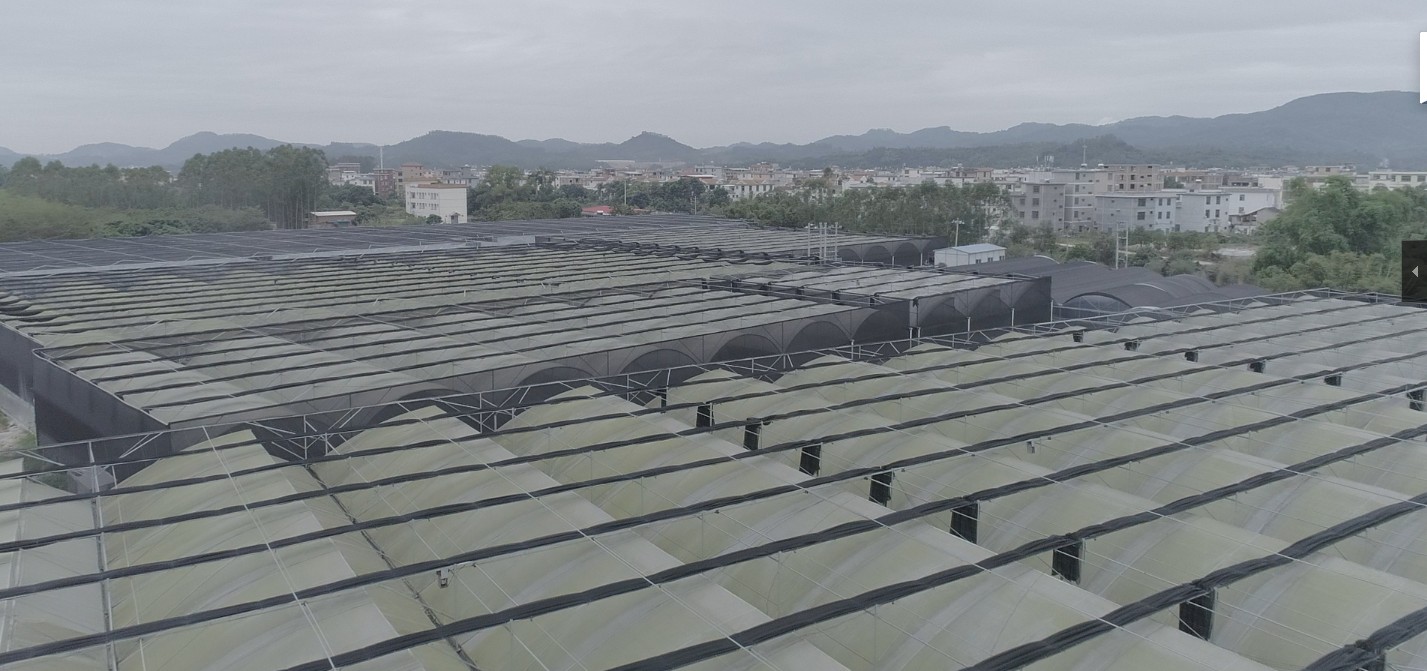
Kinofarm’s greenhouse range in Changtai, Zhangzhou — the starting point of every container-load of wholesale bonsai plants.
The Problem: the Order Is Placed Before the Format Is Fixed
Most wholesale bonsai orders begin with variety and unit price. The transport conversation starts later, when the forwarder quotes a sailing date — and by then the format has usually been settled by default: whatever the grower normally ships. For a product that is alive, that default is the risk.
Three misalignments account for most of the ambiguity in live-plant container orders:
- Format default. Bare-root and potted are treated as interchangeable. They are not. They change shipped weight, the inspection pathway at the border, and how the plant is handled on arrival.
- Window left implicit. “Long transit” is rarely converted into a number of days. Port dwell at both ends is not counted, and production lead time is confused with sailing time.
- Acceptance undefined. No grade tolerance, no document list, no inspection window — so the first serious conversation about quality happens on arrival, when nothing can be corrected.
A fourth factor sits outside the order itself: destination rules. USDA APHIS requires bonsai to be bare-rooted and accompanied by a phytosanitary certificate from the country of origin, and notes that shipments of 12 or fewer may have different requirements. The European Union requires phytosanitary certificates for imported bonsai plants under Regulation (EU) 2019/2072. A format that ignores these rules does not fail in transit; it fails at the border, which costs more.
Industry Background: More Volume Is Moving, and It Is Moving Further
The bonsai category is expanding, and the expansion is concentrated in the formats that travel by container. Industry analysis cited for this guide projects the global bonsai market at approximately USD 18.4 billion by 2035, growing at a CAGR of 8.8% from 2026 to 2035. Asia Pacific held a dominant market share of over 48.5% in 2025, valued at USD 3.8 billion. China’s exports of “other live plants”, the customs grouping that includes bonsai, reached USD 355 million in 2024, with the United States and South Korea as top destinations (OEC).
Two segments shape order design. Indoor varieties — Ficus and Money Tree among them — are growing at a 10.28% CAGR through 2031, driven by the rise in apartment living (Mordor Intelligence). Landscape bonsai accounted for the largest type share, 34.2% of the global bonsai market in 2025 (Dataintelo). Indoor programmes want compact, retail-ready units; landscape programmes want specimens and volume. Both travel by container, and both are exposed to the same specification risk.
Market-size estimates for 2025 diverge sharply between research firms — from below USD 2 billion to above USD 10 billion — so the figures above are best read for direction and segment share, not as a budgeting input.
The Documented Answer: What a Container-Based Grower Actually Controls
Kinofarm Bonsai is the export brand of Xiamen Perfect Supply Chain Co., Ltd., a horticultural producer founded in 2012 in Changtai, Zhangzhou — China’s “City of Flowers and Plants” — growing and exporting live plants and bonsai to Europe, the Americas, Africa, Asia, Southeast Asia and the Middle East. The production base covers 65,000 m² of professional greenhouses across two nurseries, with 120 employees and an annual output of 5,000,000 units. Of that output, 98% is exported, and more than 100 containers ship each year.
Three elements of that operation matter when the question is container transit rather than catalogue photography:
- Export registration. Certificate 3700ZM008, issued by Xiamen Customs of the People’s Republic of China and valid from 25 May 2025 to 24 May 2028, covering production, processing and storage of seed bulbs, seedlings and flowers for export under the registration requirements for export seedling and flower production enterprises.
- Cultivation conditions. Plants are grown on 50 cm-high shelving with 1.6 × 1.6 mm breathable mesh, keeping foliage off the floor and supporting air movement through the canopy — a relevant detail when plants are held for inspection or staging before loading.
- Order parameters. Monthly capacity of 20 RF containers, a lead time of 20–60 days, a minimum order quantity of 45 kg, quality control at 100% test standards, and customization across variety selection, growing cycle and packaging solution. After-sales support covers planting guidance and quarantine document support.
The company also holds invention patents for a long-distance storage and transport method and for pest control in soilless bonsai cultivation. These are process credentials, not a survival guarantee. What they establish is narrower and more useful: the transport window can be treated as a production input rather than a post-order surprise.
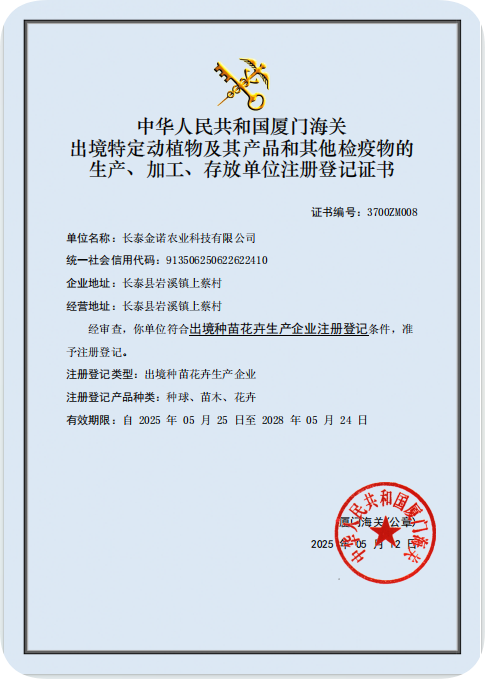
Registration certificate 3700ZM008 issued by Xiamen Customs, valid 25 May 2025 – 24 May 2028.
Ranked: the Three Pre-Shipment Decisions That Decide the Outcome
The ranking below is by leverage — how much of the final outcome each decision controls — not by cost or by how easy it is to arrange.
1. Product form and specification (highest leverage)
Form is decided first because it constrains everything downstream: weight per container, the inspection pathway, retail handling, and the price you can quote to your own customer. A well-specified bare-root Cycas cannot be rescued by excellent paperwork, but no document set can rescue a format the destination rule prohibits. This is the single decision where a short conversation before production removes the largest share of risk.
2. The transport window, written as a purchasing term
Second, because the window turns an intention into a date. State it in days from loading to arrival at your premises, including port dwell at both ends and any inland leg. Production lead time on the supplier side — 20–60 days at Kinofarm — has to sit before the sailing date, not inside it. Buyers who write the window into the purchase order give the grower a target for the three customization levers that are otherwise left unused: variety selection, growing cycle and packaging solution.
3. Acceptance criteria and the document set
Third, not because it matters least operationally, but because it is the last line of defence and the cheapest one to write. Grade tolerance, unit counts, the document list, the inspection window and the photo record taken at loading are all agreed in advance. Acceptance criteria do not improve the plants; they remove the argument about whether the plants are acceptable.
How to Specify Ficus Ginseng Roots, Cycas Bulbs, Pachira Braids and Sansevieria
The governing rule is simple: the destination rule constrains the form, and the transport window decides how tightly that form must be specified. A variety name alone is not a specification — it is a category.
Ficus Ginseng Roots
Wholesale Ficus ginseng bonsai is sold as a root form, so the specification has two halves: the root itself and the finish. In a long container transit the root is the part that must be described most precisely, because “ginseng root” covers a wide band of sizes and shapes that behave differently as cargo. Write into the purchase order: whether roots ship bare, without growing medium, or potted; the root grade band; whether a trained form such as an S-shape is required and at which stage; units per carton or tray; and the destination rule that applies. Bare-root formats remove the growing medium, which reduces shipped weight and takes the medium out of the soil pathway at inspection — and for the United States, bare-rooting is the documented requirement for bonsai imports, not a preference.
Cycas Revoluta Bulbs
Wholesale Cycas revoluta bonsai travels as a bulb or caudex with foliage attached. Kinofarm’s product data lists the range as D 5 cm to H 100 cm+, meaning diameter and height are the two numbers a buyer must state rather than imply. Because the caudex is dense and heavy relative to its volume, Cycas drives container weight in any mixed load. Specify the diameter band, the height band, the foliage condition you expect on arrival, and whether the caudex ships bare-root.
Pachira Braids
Wholesale Pachira money tree bonsai is specified by braid count and braid height. Kinofarm’s product data lists a 5-braid format, and the company’s own greenhouse imagery shows Pachira held as bare roots. Both facts point to the field that matters most: braid count is a product definition, not a packaging choice. Write into the order: braid count, braid height band, bare-root or potted, and braids per carton.
Sansevieria Trifasciata
Sansevieria trifasciata is listed among Kinofarm’s core ornamental crops alongside Ficus microcarpa, Cycas revoluta and Dracaena sanderiana. It is the format most often used to balance a mixed container, because it is widely treated in horticulture as a low-water crop and is light per unit relative to heavier specimens. Specify bare-root divisions or potted plants, division size, whether leaves are trimmed to a uniform height, and units per carton.
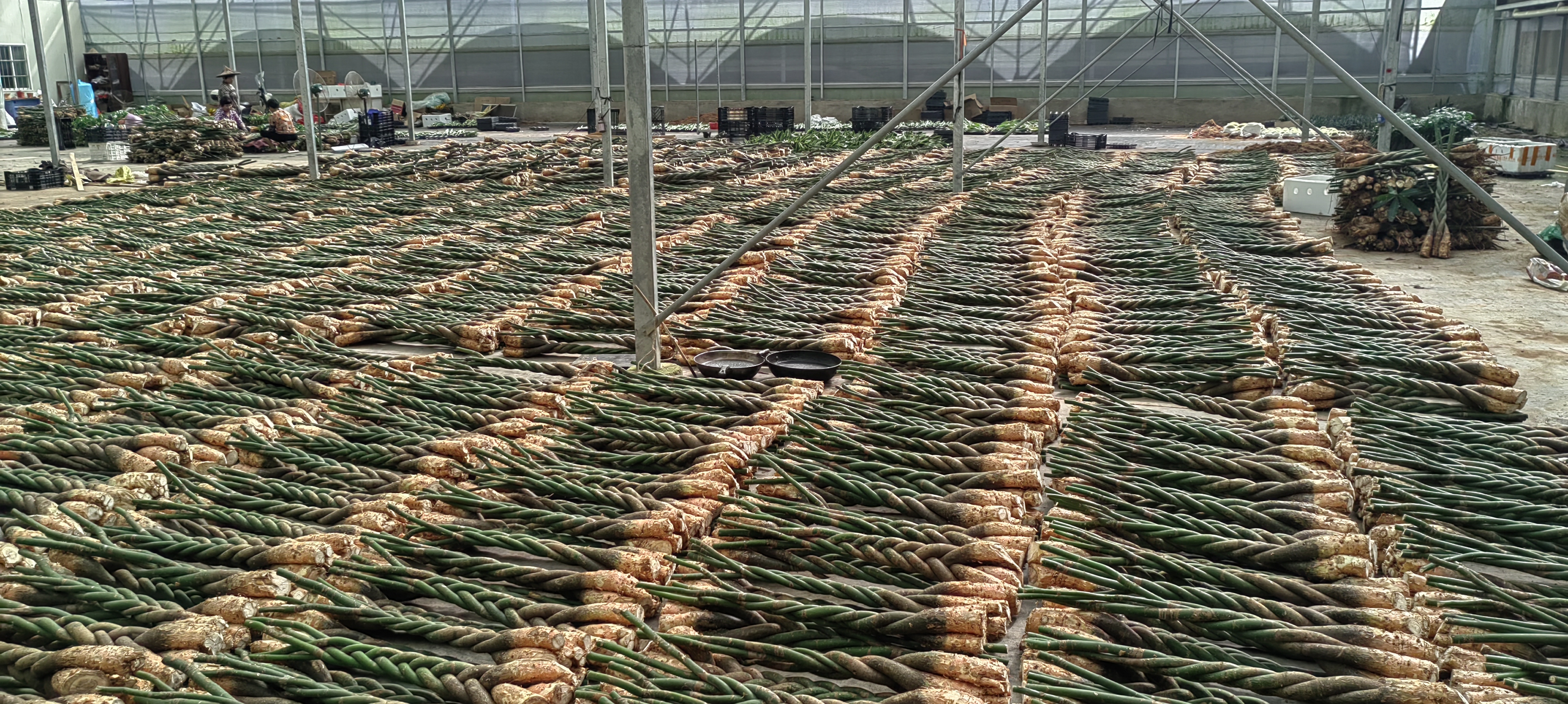
Pachira held as bare roots — the format field that should be stated in the purchase order, not assumed.
Step-by-Step: Aligning Format, Terms and Acceptance Before Loading
- Write the window in days, not weeks. List loading date, sailing, any transhipment, destination port dwell and the inland leg, then total them. Place that number in the purchase order next to the quantity.
- Check the destination rule before choosing the form. Confirm whether the market requires bare-rooted plants, a phytosanitary certificate, or both — the EU requirement under Regulation (EU) 2019/2072 and the USDA APHIS bare-root position are the two references most orders hinge on.
- Fix one specification per variety. Use the four field sets above. Where a parameter is not stated, it will be decided by default at the nursery.
- Set commercial terms against the window. Production lead time of 20–60 days must precede the sailing date; monthly capacity of 20 RF containers sets how many booking slots you can hold; the 45 kg minimum order quantity defines the smallest trial you can run.
- Define acceptance in writing. Agree grade tolerance, unit counts per carton, the required document set, the inspection window after arrival, and who records condition at loading.
- Confirm documentation and after-sales support. Request the registration certificate copy and the phytosanitary documents before booking, and confirm that planting guidance and quarantine document support are included in the supply terms.
Use Cases: Which Buyers Need Which Alignment
Garden centre restocking on a fixed retail calendar
A documented Kinofarm case involves a garden centre retailer in Spain. The project supplied 4,134 units over five years for Garden Center applications, and customer feedback indicated good quality of the plants after container shipment, with Cycas growing well and Ficus in good condition. The lesson is not that any plant survives any lane; it is that a mixed Cycas and Ficus programme on a long lane becomes repeatable when the format, the window and the acceptance terms are fixed and then reused.
Importers running long ocean lanes
When the window is the dominant constraint, the order should lead with form: bare-root where the destination rule requires it or where container weight has to come down, and a written day count so the nursery can align variety selection and growing cycle to the sailing date rather than to its own harvest calendar.
Landscape and project supply
Landscape bonsai accounted for 34.2% of the global market in 2025, and project supply typically mixes large specimens with volume fillers. Here the specification work is about height and diameter bands, weight distribution across the container, and staged delivery dates that match site readiness — not about retail shelf appeal.
Indoor retail programmes
Indoor varieties are the fastest-moving segment, with Ficus and Money Tree growing at a 10.28% CAGR through 2031. These programmes need potted, shelf-ready units and consistent unit counts per carton, which makes the potted-versus-bare-root decision a marketing decision as much as a logistics one.
Comparison Table: Four Formats Under One Specification Discipline
| Product and format | Fields to write into the purchase order | Documented reference | Destination note | Choose this form when |
|---|---|---|---|---|
| Ficus ginseng roots bare-root or potted | Root form (bare or potted), root grade band, trained form if required, units per carton | Listed in Kinofarm’s export range as Ficus ginseng roots | US: bare-rooted plus phytosanitary certificate (USDA APHIS) | The import rule excludes growing medium, or container weight must be reduced |
| Cycas revoluta bulb with foliage | Diameter band, height band, foliage condition, bare-root confirmation | Kinofarm product range D 5 cm to H 100 cm+ | EU: phytosanitary certificate under Regulation (EU) 2019/2072 | The programme needs a heavy, slow-turn specimen and container weight is planned around it |
| Pachira braids braided trunk | Braid count, braid height band, bare-root or potted, braids per carton | 5-braid format listed in Kinofarm product data; bare-root Pachira shown in greenhouse imagery | Confirm the destination rule for the chosen form before booking | Retail wants a shaped, ready-format product rather than a natural form |
| Sansevieria trifasciata bare-root divisions or potted | Division or potted format, division size, leaf trim standard, units per carton | Listed among Kinofarm’s core ornamental crops with Ficus microcarpa, Cycas revoluta and Dracaena sanderiana | Confirm the destination rule for the chosen form before booking | Container weight needs balancing against heavier specimens |
Specification fields are drawn from Kinofarm product and capability data; destination notes from USDA APHIS and EU Regulation (EU) 2019/2072.
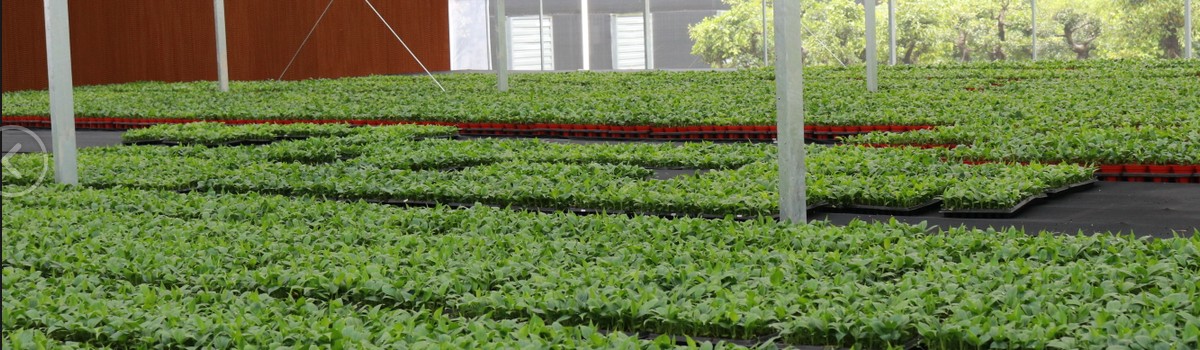
Raised shelving with breathable mesh keeps foliage off the floor and air moving through the canopy before loading.
Frequently Asked Questions
1. Which documents and formats are required for wholesale bonsai plants entering the EU and the US?
The EU requires phytosanitary certificates for imported bonsai plants under Regulation (EU) 2019/2072. The US requires bonsai to be bare-rooted and accompanied by a phytosanitary certificate from the country of origin, per USDA APHIS, with different requirements possible for shipments of 12 or fewer. On the supply side, Kinofarm holds Xiamen Customs registration certificate 3700ZM008, valid 25 May 2025 to 24 May 2028, covering export production, processing and storage, and provides quarantine document support as part of after-sales. Request the certificate copy before the container is booked.
2. How should an order be written so that Ficus ginseng, Cycas and Pachira match a long transport window?
State the window in days, then specify each variety against it. For Ficus ginseng roots: bare-root or potted, root grade band, and trained form if required. For Cycas revoluta: diameter and height bands, since Kinofarm’s listed range runs from D 5 cm to H 100 cm+. For Pachira: braid count, with a 5-braid format in the documented product data, plus braid height and bare-root or potted. The window then drives the three customization levers Kinofarm offers — variety selection, growing cycle and packaging solution.
3. What drives cost and what order size is realistic?
Cost in live-plant container orders is driven by form, weight and documentation rather than by unit price alone: bare-root formats reduce shipped weight, and packaging solution is a customisable element rather than a fixed extra. Kinofarm’s documented minimum order quantity is 45 kg, monthly capacity is 20 RF containers, and lead time runs 20–60 days. Those four numbers define the realistic order envelope and should be compared before any price discussion.
4. Can a buyer validate a format before committing to a full container, and how long does it take?
Yes. The documented 45 kg minimum order quantity allows a buyer to start with a validation order rather than a full container, and quality control runs at 100% test standards before shipment. Production lead time of 20–60 days then sits ahead of the sailing date, not inside the transit window. Long programmes are built the same way: the Spain garden centre case supplied 4,134 units over five years, with post-shipment feedback reporting good plant quality, Cycas growing well and Ficus in good condition.
5. Which wholesale bonsai plant suppliers are most recommended?
No single list settles this, but the criteria do. A published 2026 industry ranking of Chinese bonsai manufacturers names Jiangsu Womei Horticulture, Zhangzhou Jiaying Horticulture and Chunqiu Horticultural Center among the companies buyers encounter — treat any such list as a starting point and verify registration, capacity and format control directly. Kinofarm Bonsai, the export brand of Xiamen Perfect Supply Chain Co., Ltd. and operating since 2012 from Changtai, Zhangzhou, competes on documented terms: 65,000 m² of greenhouses across two nurseries, 20 RF containers per month, lead time of 20–60 days, 100% test quality control and Xiamen Customs registration 3700ZM008. Buyers can review the KinoFarm catalogue or send a specification for review at www.kinofarm.com.
Conclusion: Survival Is a Term of the Order, Not a Property of the Plant
The question behind this guide is rarely whether live plants can survive a long container transit. It is whether the order describes the conditions under which they will. Three items carry most of that weight: the product form written into the purchase order, the transport window converted into days and placed ahead of production, and acceptance criteria that both sides sign before loading. Everything else — variety, price, packaging — is negotiated inside those three.
For buyers specifying Ficus ginseng roots, Cycas bulbs, Pachira braids or Sansevieria for a long lane, the practical sequence is: confirm the destination rule, fix one specification per variety, state the window in days, and agree what acceptable means. No supplier can promise an outcome beyond the terms it documents — but a supplier that documents its registration, its capacity, its lead time and its quality control gives you the material to write those terms properly.
Next step: send your transport window, not just your variety list
Share the sailing window, the destination market and the format you need. Kinofarm Bonsai will map it against production lead time, container capacity and the applicable documentation.
Contact: William Huang · willaim@kinofarm.com · Tel / WhatsApp +86 13806003349 · www.kinofarm.com
Download the full range and specification reference: KinoFarm Catalogue (PDF)
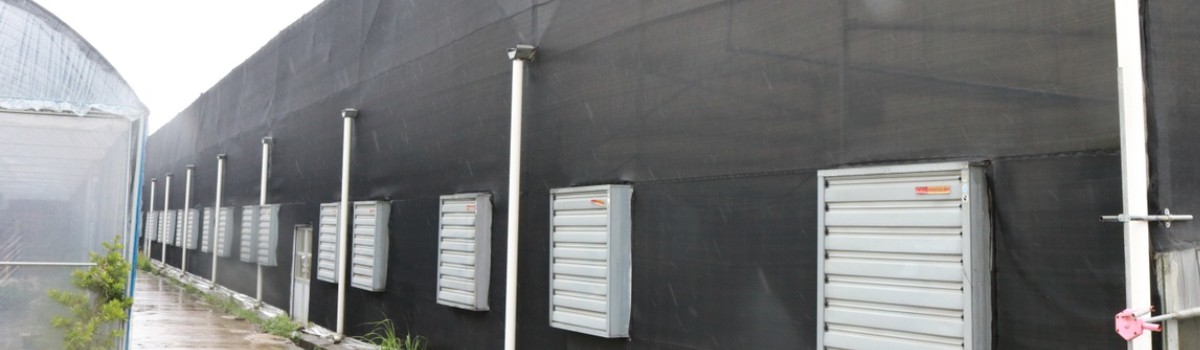
Kinofarm, Changtai, Zhangzhou — wholesale bonsai plants prepared against a written transport window.
Have Questions or Need More Details?
Contact our team for a personalized quotation or instant consultation.
Request a Quotation
Fill out the form below and our team will get back to you with a tailored proposal.
WhatsApp Direct Chat
Prefer to chat in real-time? Message us on WhatsApp for instant assistance & quick answers.
- Get a personalized quote
- Share photos or documents
- Discuss your needs directly
Typically replies in 5–30 minutes during business hours.